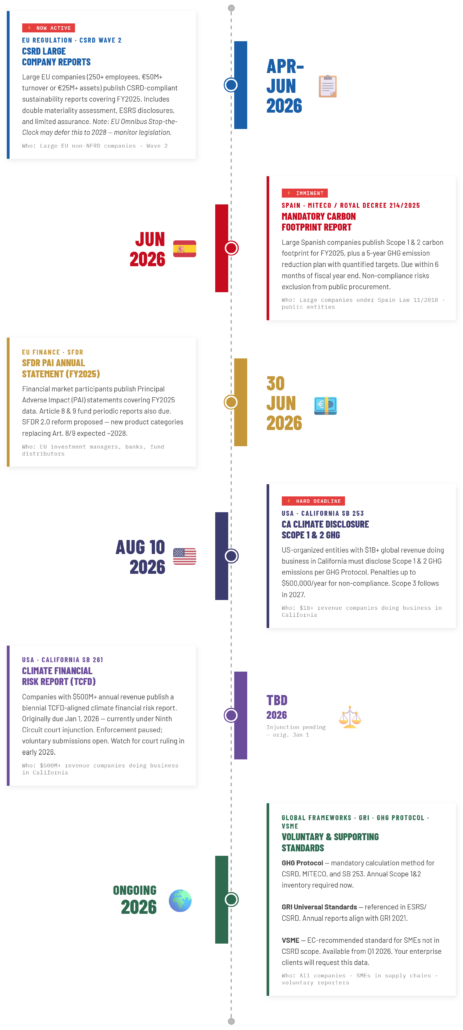
Prazos para o relatório de sustentabilidade de 2026
O tempo está a passar. E para muitas empresas, o alarme ainda não soou.
A elaboração de relatórios de sustentabilidade já não é um ato voluntário de boa vontade. Tornou-se uma densa teia de obrigações legais que se sobrepõem – com prazos reais, aplicação real e consequências reais para o seu incumprimento.
Se és um CFO, gestor de sustentabilidade ou executivo de uma empresa a operar na Europa ou nos EUA, 2026 não é apenas mais um ano. É o ano em que vários dos quadros de sustentabilidade obrigatórios mais importantes do mundo convergem pela primeira vez.
Eis o que tens de saber – e quando.
🇪🇺 CSRD — The European Reporting Revolution
The Corporate Sustainability Reporting Directive (CSRD) is the EU’s landmark sustainability law. It replaces the old NFRD and dramatically expands the scope of who must report, what they must report, and how.
Key deadlines:
2025 — Already here. Companies previously subject to the NFRD (large listed companies, banks, and insurers with 500+ employees) published their first CSRD-compliant reports this year, covering FY2024. If you’re in this group, you’re reporting now.
2026 — Large EU companies that weren’t previously under the NFRD (250+ employees, €50M+ turnover or €25M+ assets) should be reporting for FY2025. Important: the EU’s Omnibus “Stop-the-Clock” Directive may defer this wave to 2028. Stay alert — the final ruling is still working through national transposition.
2027 → 2029 — Listed SMEs and non-EU companies with €150M+ in EU revenue eventually come into scope.
What does CSRD require? A double materiality assessment, reporting against European Sustainability Reporting Standards (ESRS), independent third-party limited assurance, and disclosure embedded in the management report — not a separate PDF.
🇪🇸 MITECO / Spain — Moving Faster Than Brussels
Spain is not waiting for the EU to catch up. Royal Decree 214/2025, which came into force in June 2025, makes carbon footprint reporting legally mandatory for large Spanish companies.
What this means for you:
You must calculate your Scope 1 and Scope 2 carbon footprint for FY2025.
You must publish a five-year GHG emission reduction plan with quantified targets.
Both must be made publicly available within six months of fiscal year end — meaning reports are due by June 2026 for most companies.
The report is published on your website or via Spain’s national carbon registry, managed by the Ministry for Ecological Transition (MITECO).
Non-compliance risks exclusion from public procurement — a major financial exposure.
Scope 3 remains voluntary for private companies, but is mandatory from 2028 for public authorities.
🇺🇸 California SB 253 & SB 261 — The US Enters the Arena
California has become the first US state to mandate climate disclosure at scale.
SB 253 (Climate Corporate Data Accountability Act):
Applies to US-organized entities with global revenues exceeding $1 billion doing business in California.
Requires annual disclosure of Scope 1 and Scope 2 GHG emissions following the GHG Protocol.
First reports covering FY2025 are due August 10, 2026.
Scope 3 reporting begins in 2027, covering FY2026.
Penalties of up to $500,000 per year for non-compliance.
SB 261 (Climate-Related Financial Risk):
Applies to companies with $500M+ annual revenue doing business in California.
Requires a biennial TCFD-aligned climate financial risk report published on your website.
The January 1, 2026 deadline is currently paused by a Ninth Circuit court injunction. Watch this space — it will be resolved in early 2026.
💶 SFDR — For Financial Market Participants
If your organization manages investment funds or provides financial advice in the EU, the Sustainable Finance Disclosure Regulation (SFDR) is your framework.
Annual PAI (Principal Adverse Impact) statements are due every June 30 — the next cycle covers FY2025, due June 30, 2026.
Article 8 and 9 funds must publish periodic reports disclosing sustainability performance.
The EU has proposed SFDR 2.0 (November 2025) — a major overhaul replacing Article 8/9 with new product categories. Earliest application: 2028.
Even when voluntary, these frameworks are becoming deeply embedded in mandatory reporting:
GRI Universal Standards 2021 — Referenced by ESRS/CSRD. If you’re reporting under CSRD, GRI concepts apply whether you like it or not.
SASB/ISSB sector standards — ISSB’s IFRS S1/S2 is being adopted by the UK, Japan, Australia, and Canada. The global baseline is converging.
GHG Protocol — The mandatory calculation methodology for California SB 253, MITECO, and widely expected in CSRD/ESRS. You cannot report emissions without it.
VSME (Voluntary SME Standard) — For companies not in CSRD scope, the EC now recommends this simplified framework. If your clients or suppliers are subject to CSRD, they will ask you for VSME-aligned data.
The Real Problem: Complexity, Overlap, and Under-Resourced Teams
Here’s what we hear from companies every week:
“We don’t know which regulation applies to us.”“We have the data somewhere, but we don’t know how to structure it.”“Our sustainability team is one person — or doesn’t exist yet.”“We were told we had more time. Now we don’t.”
The regulations are not necessarily impossible. But navigating five overlapping standards, coordinating data across departments, running a double materiality assessment, and preparing for third-party assurance — all while running a business — is genuinely hard.
What Happens If You Miss the Deadline?
CSRD: EU member states are implementing enforcement regimes. Sanctions vary, but reputational risk and audit failure are immediate consequences.
MITECO: Exclusion from Spanish public procurement processes (affecting 18% of GDP exposure).
California SB 253: Up to $500,000 per year in penalties.
You don’t need to solve everything at once. The best time to start was two years ago. The second best time is today.
At TSN — The Sustainability Network, we help companies across Europe and the United States navigate every major sustainability reporting obligation. We’re not just consultants — we become part of your team.
Do any of these sound familiar?
❓ Don’t know where to start?
😤 Feeling overwhelmed by the acronyms and overlapping standards?
👥 Not enough team members to run the process?
📅 A deadline is approaching and you’re not ready?
We have a free 30-minute session for exactly this moment.
In our call, we’ll map out which regulations apply to your company, identify your most urgent deadlines, and outline a realistic roadmap — no jargon, no pressure.
TSN is a sustainability consulting and reporting firm helping companies across Europe and the US achieve compliance with CSRD, MITECO, GHG Protocol, California SB 253, SFDR, and global ESG frameworks.
POST FORMAT NOTE: For LinkedIn native article: post as full article with header image (use the timeline visual). Then write a short companion post (below) to drive traffic to the article.